



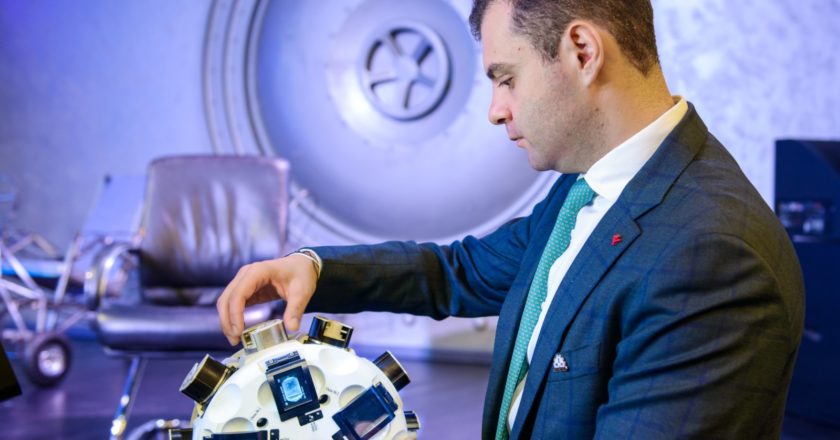
Russian cosmonaut Oleg Skripochka, currently on his ISS mission, conducted a successful experiment in synthesizing cultured meat using Organ-Avt, a Russian bioprinter. The technology proved effective and is now eligible for wider application.
Russian cosmonaut Oleg Skripochka successfully completed the first in history experiment in 3D-printing different kinds of meat in orbit. Scientists believe the experiment opens a new era of Russian bioengineering and will create a billion-dollar-worth food market for Russian businesses. Roscosmos State Corporation, 3D Bioprinting Solutions, Invitro and Aleph Farms are the companies involved in the project.
Russia-produced magnetic bio-printer, Organ-Avt, was tested for its ability to produce meat in orbit without using natural resources. On Earth, producing 1 kg of beef requires 15K liters of water, 6 sq m of pasture and slaughtering an animal. In the Russian section of the International Space Station, which is orbiting 415 km from Earth, meat was synthesized in the conditions of microgravity through natural cell regeneration that is typical for live organisms.
Once scientists have studied the samples produced in space, they will prepare the cultivation technology for scaling up. Results of the experiment will serve as a basis for a prototype printing machine that can produce protein products. The products can be used both in agricultural production back on Earth and during long-haul spaceflight and planet colonization. Moreover, the bio-printer developed by 3D Bioprinting Solutions (Russia) is also used in tissue engineering and has great prospects in medical science.
The Economic Cooperation Organization predicts that within the next six years, consumption of beef in the world will increase by 8% to 27 mio tons. This being said, almost half of meat consumers are open to trying cultured meat. Provided that the price of the innovative product goes down (currently, cultured meat costs 33% higher than a premium animal product), the market may achieve a record turnover of $50 bln by 2025.
3D printing in space is one of the 77 applied scientific research programs that have been carried out in the Russian segment of the ISS. According to United Rocket and Space Corporation CEO Nikolai Burdeiny, the crew spent over 19K hours on various experiments, including commercial tests.