



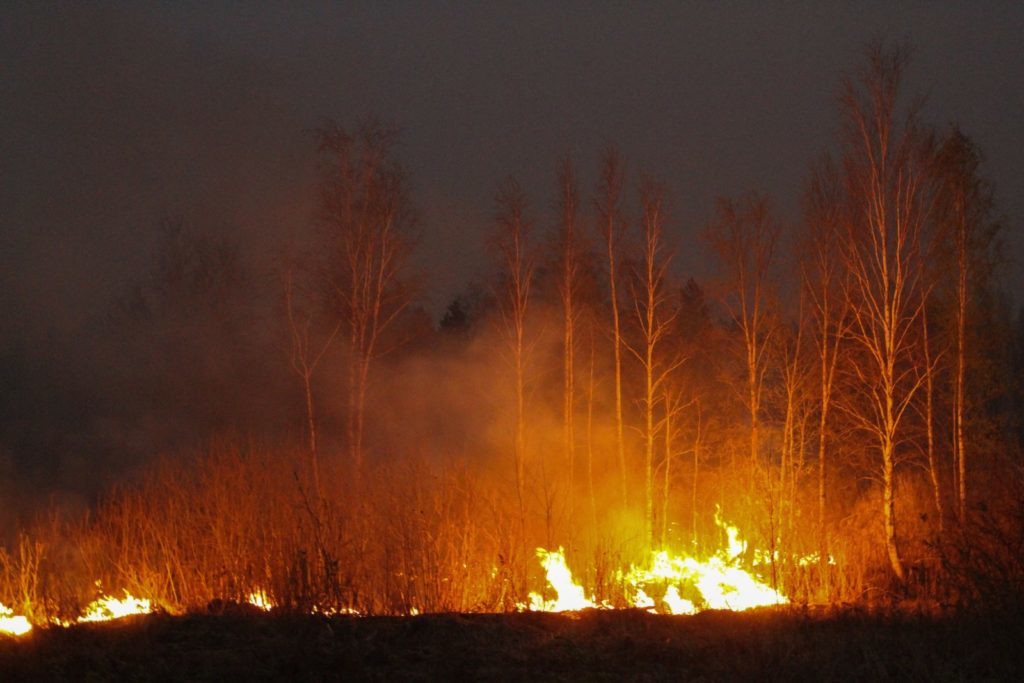
Over the past few decades, humanity has witnessed extremely destructive and large-scale wildfires throughout the planet. For example, in 2022 there were several dozen large fire disasters in forests, as evidenced by statistics. Such sad data becomes a challenge for the world community, who needs to look actively for innovative solutions in order to prevent, control and extinguish forest fires effectively.
Overview of global technology trends
After examining the report of the American research company Gartner, I want to talk about the eight main technological trends of 2023, which do not only determine the future of our society, but also discover new opportunities for business and innovation, including in such critical areas for the state like fire safety in the city and natural environment.
- Ubiquitous adoption of artificial intelligence (AI). This year, AI is more often and more widely used in organizations of various fields of activity. No-code AI-like technology makes AI use accessible to any business. It is important to note that AI improves almost every type of work and business processes in industry and business. For example, it becomes a driving force in autonomous delivery initiatives, tested and implemented by trade representatives.
- The metaverse transitions into reality. Metaverse denotes more than immersive internet, where people can work, communicate, relax and have fun on a permanent online platform. Today augmented reality (AR) and virtual reality (VR) technologies continue to develop. For example, enterprises and organizations are already using similar innovations for training and adaptation, and this trend is constantly accelerating.
- Progress in Web3. Modern blockchain technologies continued to be noticeable development in 2023 as products and services are created with greater decentralization. Non-fungible tokens (NFTs) become more useful and practical.
- The digital world connects with the physical world. Two components of such a merge are digital twins and 3D printing. Digital twins are virtual simulations of real processes used for testing innovative ideas in “digital.” Simulations are gaining popularity in production and construction. 3D printing is another aspect of this trend, due to it companies quickly build prototypes and parts based on results of digital testing.
- Active “editing” of nature. This year genetic engineering technologies are more actively used to create products and solutions that would be unthinkable just a few years ago. CRISPR technology and other gene engineering techniques not only treat genetic diseases, but also adjust human characteristics (e.g. eye and hair color).
- Progress of quantum technologies. Some companies are already developing today quantum computing technology. It can become revolutionary for many industries including cryptography, materials science, and pharmaceuticals. However, there is a lot of work to be done to make such technology available to most companies. In 2010, when I defended my thesis on analysis of dissipative dynamics of qubits (quantum bits), fiber optical networks several kilometers long, with the implemented protocol of quantum cryptography, have already been built. Now in the framework of cybersecurity this direction acquires additional relevance.
- Progress of “green” technologies. Progress in harmless technology, with carbon neutrality as a global goal, is progressing fast this year. Innovative energy generation methods like solar panels of new generation, develop energy democratization, while reducing carbon dioxide emissions.
- “Humanizing” robots. Robotics developers are trying to create robots that are virtually indistinguishable from humans, moreover, both in visual as well as functional aspects. Most likely, this year robots will appear that can interact with people even more naturally, as robotics improves in the field of AI and machine learning.
This is exactly how Gartner researchers see 2023 in terms of universal technological trends. And as a fire safety expert I am interested in using innovative solutions specifically in this area.
How the latest technology helps fight fires in nature and not only there
The latest technologies are impacting the fire safety industry by improving predicting, preventing and detecting fires, as well as eliminating their consequences.
Thanks to the introduction of new fire-resistant materials that withstand high temperatures and even fight fire, fire safety of buildings and other facilities improves. For example, using biodegradable gels that retain moisture and slow the spread of fire, helps to resist fires effectively. Such gels can be sprayed on trees and vegetation around vulnerable areas without any harm to the environment after their use.
Over time, fire safety systems will become even more integrated and automated, providing the fastest coordinated elimination of fires. And the use of VR, AR and other training technologies will make fire fight and rescue training more effective and more realistic.
So, in the fight against forest fires, two approaches to based on AI are developed: using images and sensors. In the first case experts use a convolutional neural network trained to find fires based on drone images. Satellites can also provide information in real-time and historical data on land coverage, temperature, humidity and other variables, which helps predict fires and manage them.
Sensory approach helps detect fires with sensors for measuring temperature, humidity, amount of carbon dioxide, hydrogen sulfide, carbon monoxide and oxygen in the atmosphere. This makes it possible to predict possible fire disasters in forest areas.
For example, the FireAId model uses AI to create a dynamic risk map, which estimates the probability of forest fires based on seasonal variables.
Advanced sensor and IoT use cases will continue to develop. This will allow to connect more devices and sensors to fire safety systems, improving their ability to detect fires and respond to them.
Among other examples of the introduction of AI in the fight against natural disasters, I would note the following:
- development of the startup Chooch – hybrid AI technology to confront devastating wildfires. The method is based on its own software that detects fires. The software is associated with a network of cameras, analyzing images every 15 minutes to look for signs of smoke or fire. Using generative AI helped reduce false positives from 2000 per week to 8.
- AI systems that are used to reduce the risk of forest fires as part of initiatives of the World Economic Forum. Similar systems work with dynamic risk maps and rank the probability of fires based on seasonal variables. AI optimizes resource allocation using dynamic map capabilities and other sources.
- Innovations to improve the efficiency of rescuers. Technologies of computer vision, helping rescuers in conditions of insufficient visibility. As well as sensors that track oxygen, body temperature and other indicators during rescue operations. Machine learning model classifies this information and alerts you to a potential hazard.
- AI-based AUDREY solution developed by NASA analyzes the environment information and recommends the safest action plan. For example, if AUDREY will detect high levels of toxic gases, it warns people in the danger zone, offering them the optimal way out. Modern technologies allow to warn the public about fires faster and more accurately using smartphones, social media and other digital platforms.
- Robotics has long proven its effectiveness in rescue operations in all corners of the world. A striking example is the fire at Notre Dame Cathedral, when together with people a robot was extinguishing the fire. His help was really colossal, since firefighters could not contain the fire for a long time due to intolerable temperatures inside the cathedral. And there are many such examples. Robots and unmanned systems will be more actively used to extinguish fires in inaccessible or dangerous places for people.
What’s important to remember when you Innovate in fire safety
Large forest fires in Russia occur annually. In spring 2023 a series of fires began, affecting about 70 regions. In May alone, the fire covered about 600 thousand hectares in Siberia and the Far East. Hot weather and strong winds made it difficult to eliminate the fire, so local authorities introduced an emergency regime in the regions and a ban on visiting forests. Since the problem remains acute, its solution requires innovative approaches – this is the only way to change the situation for the better.
Thanks to technological progress and the development of artificial intelligence there are new prospects for fire alarm systems. In the coming years the use of AI and machine learning will increase efficiency of systems in detection and prevention of fires, determination of optimal ways to combat fire, reducing the number of false actuations, which is especially important given the frequency and scale of natural disasters.
Despite all the advantages of new technologies, it is important to maintain a balance between their use and traditional safety practices. Innovative solutions should serve as a complement, not a substitute of proven and reliable methods that have long been used in fire fighting. At the same time, we must not forget that the competent use of new technology requires training of personnel and additional investments in upgrading equipment and infrastructure.
Overall, the future of fire safety systems looks promising, with great potential to fight successfully fires of any nature. New advanced technologies are created not only for preservation of valuable natural resources, but also for the protection of housing, property, life and people’s health.

By Alexander Gelman, Head of Aluf