



Russian developers have more than halved the planning horizon – up to one and a half years instead of the usual three to five. Anton Glushkov cited figures: the volume of investments in projects with exit in 2026 decreased by 30-35% compared to 2021, for projects in 2027 it is planned to reduce supply by another 15-20%. In Phuket, the opposite picture: the market is growing, in 2026 10,020 condominiums in 39 projects should be commissioned on the island. I have been investing in real estate for over twenty years, started in Moscow and the region, now I work in Phuket, so I see both markets from the inside. Let’s figure out whether ten thousand new apartments are really overheating, what is hidden behind the promises of 15% per annum and how an investor in Thailand should make decisions in order to get real legal protection for his investments, and not the illusion of security.
Two phases of the same cycle
Cooling and overheating – this is how it looks from the side. In fact, in my opinion, both markets are now going through different phases of the investment cycle.
In Russia, developers today work in conditions of expensive capital, reduced availability of mortgage financing and high uncertainty. When the value of money rises, business naturally shortens the planning horizon. Therefore, reducing the volume of new projects is not a sign of weakness in the industry, but a rational response to changed economic conditions. Developers prefer to focus on completing ongoing projects and maintaining financial stability, rather than aggressive expansion.
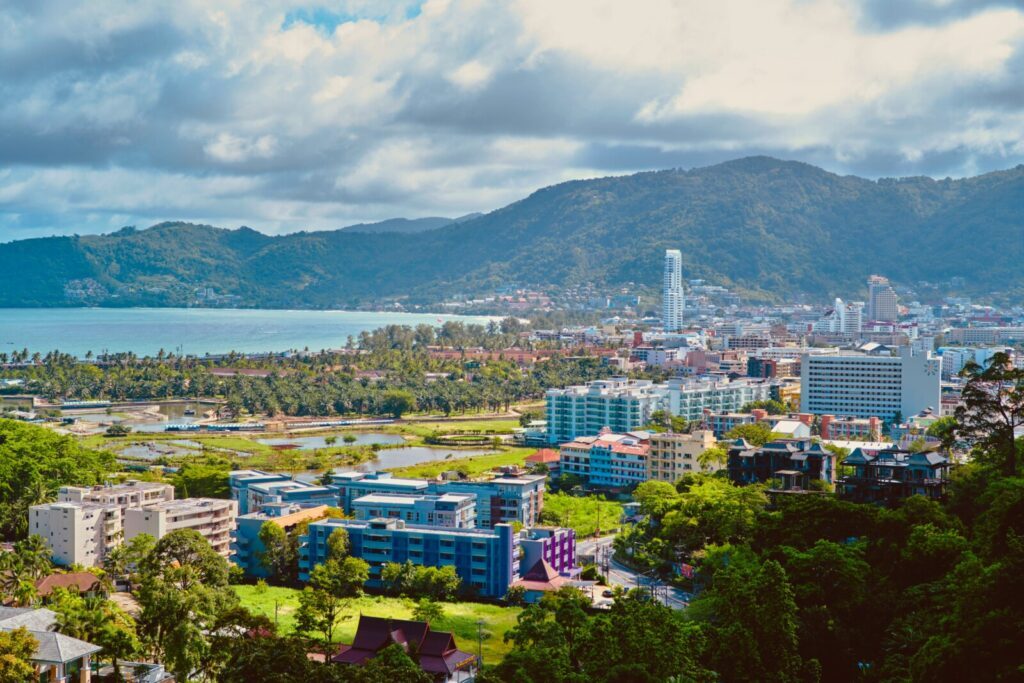
Phuket, on the contrary, found himself in a completely different situation. Here, demand is shaped not by Thailand’s domestic economy, but by global capital flows. Today, housing on the island is bought not only for the sake of recreation. For many investors, this is a way to diversify assets, protect capital from currency risks and get real estate in one of the fastest growing tourist locations in Asia.
Supply in Phuket is growing not because developers want to build more, but because the market has time to absorb new projects. Developers are tracking the pace of sales, and as long as demand remains strong, they continue to launch new construction phases.
But that’s not the whole picture. In the capital of the country, new projects come out much more cautiously – according to the Bangkok Post, the launch of condominiums in Bangkok in 2025 fell by 41%, that is, the largest Thai developers are shifting their focus to Phuket. This suggests that they see the main growth potential not in the domestic housing market, but in international demand.
Russians remain among foreign buyers the second largest group, second only to the Chinese: in the first quarter of 2026, Russian citizens bought 383 condominiums in Thailand, which is 33% more year-on-year, in the amount of 1.665 billion baht (about $52.7 million). But it would be a mistake to assume that they determine the market. Today Phuket is an international investment platform where investors from China, Russia, Europe, India, Singapore, Australia and the Middle East are simultaneously investing. Such a wide geography of buyers makes the market much less dependent on the economic situation in any one country.
In my opinion, a more important process is taking place now than just an increase in construction volumes. The very logic of private capital behavior is changing. Wealthy people increasingly form international portfolios, distributing assets between different jurisdictions, so that foreign real estate becomes an instrument of currency diversification, capital protection and improving the quality of life.
Ten thousand apartments – overheating or healthy growth
The figure of ten thousand new apartments in itself does not mean overheating. It is much more important to understand exactly where this housing is being built, who is building it and for whom it is intended.
Phuket real estate cannot be seen as a completely unified and homogeneous market. Each district has its own economy, its own audience and its own balance of supply and demand. In some locations and price segments, competition has already noticeably increased, while in others, demand continues to outpace the commissioning of new projects. Therefore, it is more correct to talk not about the overheating of the island’s market as a whole, but about its high selectivity.
How customer behavior has changed
If earlier investors more often focused only on the beautiful presentation of the project and the promised profitability, today they carefully analyze the developer himself, the concept of the complex, the quality of management, future liquidity and resale prospects. We can say that the market is becoming more mature. The era when almost any object grew in price is a thing of the past – today it is more legend than reality. We see that projects from developers with an impeccable reputation, located in popular areas, with well-thought-out infrastructure and professional management, are losing less in price and gaining it faster.
Leasehold: What has changed as a result of high-profile Supreme Court ruling
The decision of the Supreme Court of Thailand of March 18, 2025 invalidated the popular lease extension schemes “30+30+30 years” – the pre-promised automatic extension does not create an unconditional legal right for the next term. This once again reminded investors that beautiful promises in agency booklets are not enough. The lease remains legal for the first 30 years, then it requires a “non-automatic” extension.
For large system developers, this, as a rule, does not become a problem: after the end of the initial lease term, the extension is formalized by a new contract in accordance with the current legislation. But for the investor today it is much more important not the formula “30+30+30,” but who is the second party to the transaction.
Five criteria for project evaluation
I always recommend paying attention to five main factors.
- Developer. How many projects have already been built and put into operation, what about his financial stability and business reputation?
- Location. We need not just proximity to the sea, but the presence of long-term demand from tourists and residents.
- Project concept. How will it differ from dozens of competitors in five to ten years?
- Economics. What matters is the realism of predicted returns based on market data, not numbers from a presentation.
- Legal review. We look at the ownership structure, land documents, form of ownership, terms of the contract and the facility management mechanism.
Can the buyer check all this on their own? Partially. Today, there is information in the public domain about the developer’s projects implemented, the dynamics of construction, the composition of the management company and the legal structure of the transaction. But a full-fledged investment analysis also requires good knowledge of the local market, so an experienced consultant helps not so much to choose an apartment as to eliminate projects that look attractive only on paper.
The main risk in 2026 is not oversupply as such. The main risk is to buy an ordinary project in the market, which is becoming more and more competitive. In the coming years, the gap between strong and weak objects will only widen. The winners will be not those investors who buy first, but those who know how to choose high-quality assets.
EIA and Chanot – two necessary but not sufficient documents
Many investors believe that if the project has EIA and Chanot, then the facility is completely safe. Alas, this is a common misconception. These documents are really extremely important, but each of them covers only a certain narrow risk area.
Chanot (Nor Sor 4) is the highest form of land title in Thailand. It confirms the boundaries of the site, registered ownership and the possibility of legal transactions. Simply put, Chanot answers the question whether the seller has the legal right to dispose of this land.
EIA (Environmental Impact Assessment) – an environmental assessment confirming that the project has received the necessary approvals in terms of environmental impact. For large projects in Phuket, the availability of EIA is one of several mandatory stages of implementation.
But neither Chanot nor EIA answer the main question for the investor: how reliable the project itself is. None of these documents guarantees the financial stability of the developer, compliance with construction deadlines, the quality of management of the future complex, the level of demand for rent or the investment potential of the object. Full-fledged verification is never limited to legal expertise.
Form of ownership and foreign quota
If a foreign buyer purchases an apartment in a condominium within a foreign quota (49% of the building area according to the Condominium Act), ownership is registered in his name. Before buying, you need to make sure that the foreign quota in a particular building is actually available. This is checked not by a booklet from the developer, but by the registration data of the object.
When it comes to villas or land, the most common form is long-term leasehold. Ownership through a Thai company also applies, but special care must be taken in this case. In recent years, Thai authorities have significantly tightened control over companies that were created solely to formally circumvent restrictions on land ownership by foreigners. The use of schemes involving nominal founders can entail serious consequences up to the forced liquidation of the company and even the confiscation of real estate.
I always tell clients: with the verification of documents, the work to ensure the security of investments is just beginning. A serious examination begins after the legal checklist is fully passed.
“Guaranteed return 15%” – where the numbers come from
When I see in advertising promises of “guaranteed profitability of 10-15% per annum,” I always recommend asking: how exactly will this profitability be formed? If there is no transparent answer with calculations, such figures should be treated with suspicion.
It is necessary to separate the indicators of guaranteed, gross and net profitability. In marketing materials, they are often mixed, from this buyers form high expectations.
Gross yield is rental income before all expenses. It is these numbers that most often appear in presentations. But the investor is not interested in this, but in a simple question: how much money will remain in his pocket after all the mandatory payments.
The real economy of the facility is taking into account the commissions of the management company, utility bills, maintenance costs, periodic repairs, taxes, downtime between arrivals of guests and the seasonality of the tourist market. According to MORE Group, at the facilities they analyzed in 2024-2025, occupancy ranged from 72 to 78%, and the net return after deducting operator commissions was in the range of 5.2-6.8%. For high-quality objects with professional management, such an indicator of net profitability today can be considered realistic.
For most experienced investors, the profit is not only from the lease, but also from the growth in the value of the asset itself – especially if you buy it at an early stage of construction from a reliable developer.
But it must be borne in mind that real estate is a low-liquid asset. If stocks or bonds can be sold almost instantly, then home sales take time. In Phuket, the duration of the exposition depends on the location, the quality of the project, the price and the state of the market. So real estate investment only makes sense with a horizon of a few years.
I always advise clients to ask to look at the financial model calculated for this particular object. It should reflect the real rental rate, load forecast, taking into account seasonality, all management and maintenance costs, scenarios for changes in profitability at different load levels and the potential resale value. If instead of calculations your see just beautiful numbers, this is a reason to be careful.
An asset that consistently yields 5-6% net return and has high value growth potential is better than the 15% that exists only in the developer’s presentation.
Why an advertising booklet will not replace a person on a construction site
Today, there is more information on the Phuket real estate market in open sources than ever before. There are analytical reports, beautiful developer presentations, photographs, virtual tours and satellite images. But none of these tools can replace personal verification of an object by an expert and professional due diligence.
Real estate is a type of investment asset where the properties of a particular object are more important than the overall dynamics and indicators of the market as a whole. Two projects located a few hundred meters apart can have completely different investment potential, different quality of implementation and level of risk.
Unfortunately, the Phuket market, like any fast-growing market, is not immune to unscrupulous participants. In December 2025, a fraud scheme was uncovered in Phuket: an agent named Chaiwat, who introduced himself as the owner of Alisha Property and Alicha Grand, sold at least ten luxury villas for 5-20 million baht, which were never completed. Total losses exceeded 100 million baht.
In recent years, the very procedure for buying real estate for Russian investors has been greatly simplified. From December 8, 2025, the Bank of Russia canceled the previously established limits on foreign currency transfers abroad for Russian citizens. However, this measure does not reduce the quality requirements for checking an object – on the contrary, the easier it is to complete a transaction, the more important it is to make sure in advance that the asset is really reliable.
When we are involved in investment support, we analyze not only documents, the availability of necessary permits, land rights, ownership and the availability of foreign quotas in a particular condominium. The developer himself is also subject to assessment – his history, financial stability, and reputation. Even when there are no questions about the developer, it remains to find out a lot more, namely, who will manage the complex after commissioning and whether the transaction is accompanied by an independent lawyer representing the interests of the buyer.
How not to buy a mediocre object amid record supply diversity
Record construction volumes in Phuket are not a local story, but a reflection of a global trend. Capital is becoming increasingly mobile and should be where high demand, predictable rules of the game, developed infrastructure and long-term growth potential are combined.
However, right now, as supply grows, the gap between strong and weak objects increases, while not too striking for investors who are just entering this market. Only the support of the transaction by a local expert allows you to reduce the level of risk to an acceptable one. Checking documents in this process is only the first step. When there are thousands of objects available, the value of the expert’s participation in the preparation of the transaction is not what he shows to the potential buyer, but what he eliminates.
By Vladimir Mironov, Director of Investment Strategies, Harmony Ocean Property