



Russia annually sees strong migration flows, as do many other countries. People move for a variety of reasons including economic, political and social ones. Russia is among the leaders in the number of migrants, ranking 3-5th in the world. Our country has been home to about 13 million migrants since 2005, with some minor adjustments due to COVID restrictions.
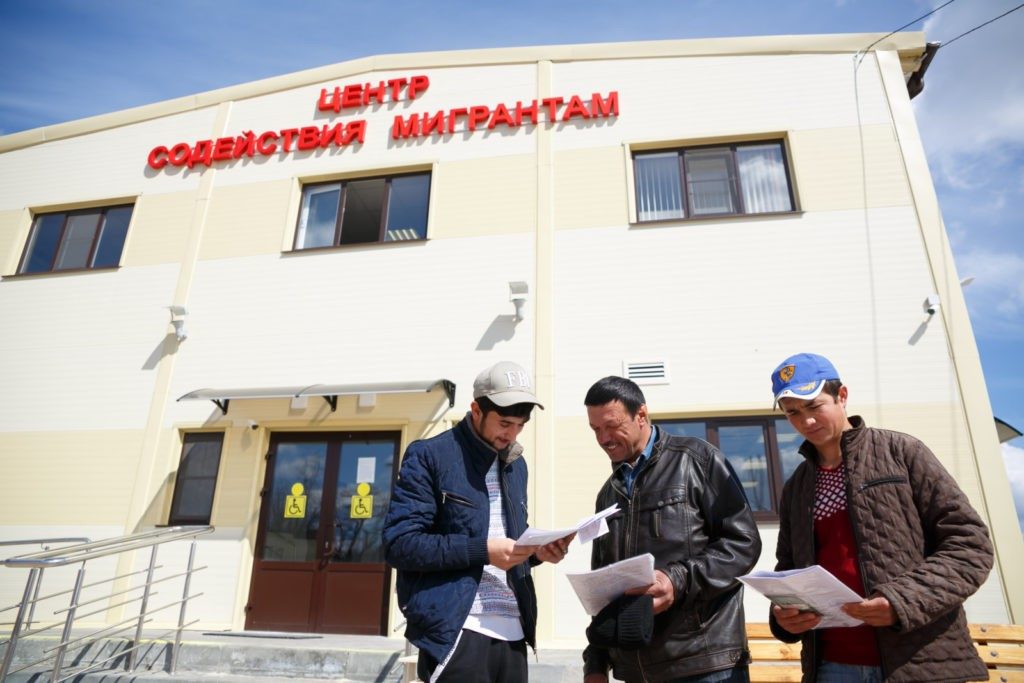
Russia is an attractive destination for labor migrants from countries where living standards and incomes are much lower. Russia’s economy offers enough low-income jobs, which are mostly claimed by migrants due to the shortage of local workforce, or jobs that are unattractive for local workers. Most migrants move from former Soviet republics, which are culturally close to Russia; some of them speak Russian, which makes it easier to find a job and integrate into the local environment. Almost 80% of migrants are from Uzbekistan and Tajikistan.
Certain industries in Russia have become specifically oriented towards immigrants in recent years. Every year, the government sets quotas for issuing work permits to foreigners, taking into account economic and social criteria and the labor market situation in each region. The largest quotas have been allocated in construction, trade, agriculture, services, and housing and utilities. But in the past seven years, the number of quotas for temporary residence permits has been reduced by almost two-thirds. Also, before the pandemic, there was no critical shortage of workforce. During the pandemic, when the borders closed, some guest workers left Russia and those wishing to enter the country were prevented by restrictions and fear of uncertainty. As a result, the population of labor migrants significantly dropped. But since late 2021, their number is consistently recovering.
The industries and regions where the share of labor migrants is particularly high have reported shortage of workforce. In big cities, the most understaffed sectors include retail and construction. As a matter of fact, the decreasing number of available workers is not the only reason for the shortage. According to job sites, the number of resumes in retail has only changed slightly while the number of jobs has grown, meaning that newly vacant positions are difficult to fill.
Of course, the subject of migrants taking jobs that could be claimed by citizens is always up for debate. It is not a secret that in the sectors that most commonly use foreign workforce, there may be many labor code violations. Migrants are willing to work for lower pay and are more lenient to labor conditions. To attract locals, companies would have to review their treatment of staff in line with labor regulations. There is also the matter of low wages; increasing wages could drive prices up. Perhaps it would be more reasonable to revisit the effectiveness of internal business processes and search for ways to optimize resources and opt for local workers.
It is impossible to forego migrant workforce completely and it should not be a goal. Labor migration is a natural process occurring in all countries in the world. The government should take measures to regulate migration flows and stimulate companies to prioritize local workers. There is plenty of experience that other countries could share. Administrative methods to regulate migration include restricting the period of stay, introducing language, education and professional experience requirements, and considering a migrant’s political and social status. Economic measures can also be effective if employers must pay state dues to the budget and foreign workers must pay higher income taxes, along with stricter patent issuance requirements.
Russia already uses all these methods although not always effectively. Both employers and guest workers extensively violate legal regulations. Employers exploit their workers and discriminate when it comes to wages and working conditions. Also, more could be done to expose illegal workers. The lack of control over migrants often results in social conflicts and breaking the law. It is where the state should toughen both administrative and economic measures. It will probably be practical to increase the price of patents for migrants and administrative fees for companies, introduce stricter requirements for education, health and professional experience of migrant workers, monitor the compliance with the law, increase fines, reduce the duration of stay in the country, and introduce heavier responsibility for wrongdoing.
There is no doubt that Russia needs migrant workers; our economy and many sectors can’t do without them. But it is necessary to strive to maintain a balance and make jobs attractive not only for migrants but for local workforce, and regulate migration flows to minimize all kinds of violations and prevent social tensions.

By Lyudmila Ivanova-Shvets, Ph.D. in Economics, Associate Professor at the Russian Chamber of Industry and Trade’s Human Resource Management Department at the Plekhanov Russian University of Economics