



Russian companies EV-Tech (Electric Vehicle Tech) and Visillect Service have joined forces to develop unmanned logistics platforms and an indoor tractor unit. So far, the efforts have resulted in building one 1.5 ton capacity device by order, and the work is underway to develop an autonomous tractor unit with the 40 ton capacity, EV-Tech co-owner and director Ilya Fedichev and Visillect Service general director Andrei Bolshakov told Invest Foresight at the seminar, Prospects for Development and Application of Machine Vision Technology.
From electric engine to driverless tractor unit

EV-Tech creates electric vehicles, both manned and unmanned, and tests them at the Kalibr technopark. The company, whose production facilities are located in Cherepovets in the Vologda Region, has received a grant from Skolkovo Foundation worth RUR 1 mio ($ 16K).
The company started its activities with developing an electric motor for Russian automobile manufacturer AvtoVAZ; sadly, the latter’s program for building electric vehicles was discontinued. Selling electric motors required such type of vehicles, and EV-Tech joined forces with together with the Volgabus company to develop an electric bus; however, the market turned out to be rather specific and its development too slow. EV-Tech’s next project was building a small 40 kW electric motor for Russia’s first driverless bus Matreshka, also for Volgabus. Matreshka was tested in five cities in different climate conditions, and carried a total of 1,000 people in Moscow during the city’s 870th anniversary celebrations. However, using autonomous vehicles for carrying passengers is not yet allowed in Russia, and the project team had to switch to transport trucks.
“We used the experience we gained while developing Matreshka to build a driverless truck”, Ilya Fedichev says. “We made a nice truck body, and the vehicle turned out to be very expensive; so we had to abandon the idea”.
The time-consuming efforts finally resulted in a driverless tractor unit project.
“All machine vision system manufacturers are expecting a vehicle without a wheel and foot pedals to appear in the market. We have made such vehicle, and it is fully autonomous”, Fedichev adds.
And this model can start bringing profit at last.
Driverless tractor unit to replace manned towing engines
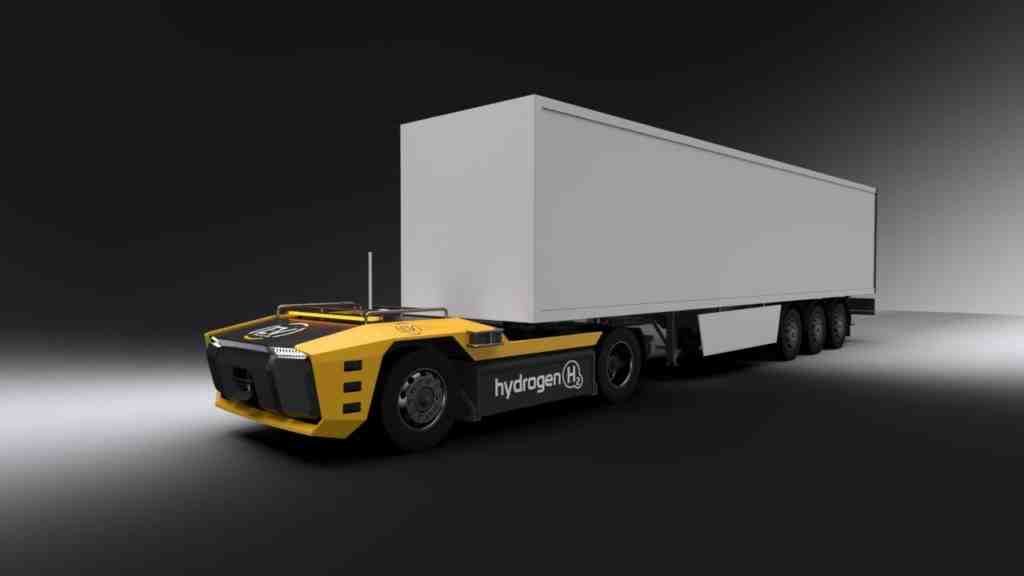
At the moment, there is only one manufactured vehicle. It is a driverless tractor unit with an automatic hitch system for hauling 40-60-ton containers and tankers. Its futuristic design is similar to that of Volvo Vera. Ordered by a major Russian oil and gas company, the autonomous tractor unit can operate as an aviation fueling vehicle. As soon as next year the company will begin testing a driverless gas tanker. It is expected that the vehicle will transfer 60 tons of fuel across the airport at the authorized speed of 30 km/h (in fact, it is 15 km/h).
An aviation fueling vehicle usually operates for only four hours a day which significantly increases personnel costs. Twenty-seven fuelers are serviced by almost 100 drivers and 100 fueling dispatchers. Unmanned vehicles could help to reduce costs.
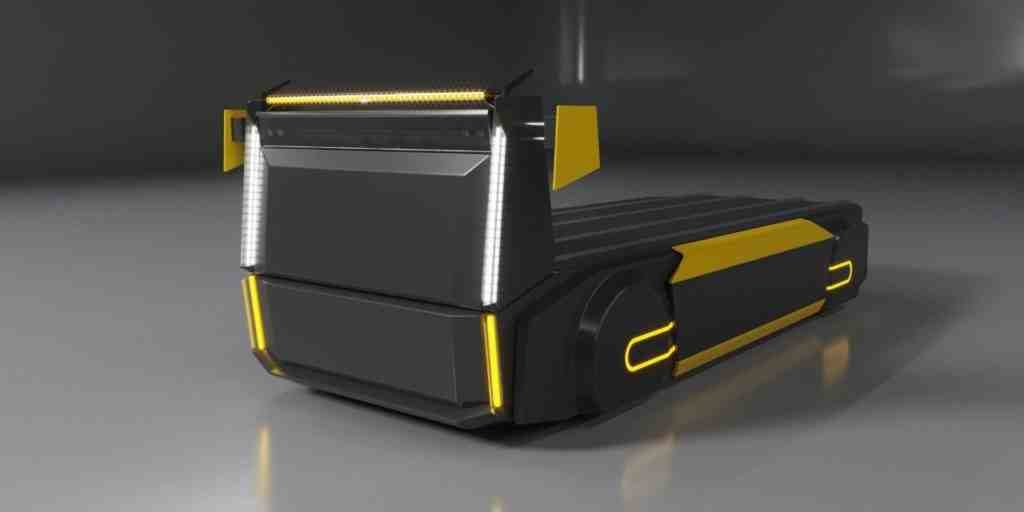
The latest development by EV-Tech and Visillect is a loading platform that can handle 1.5 tons and is intended for operating in a logistics center or other indoor facilities. One custom-made vehicle costs tens of millions of rubles but manufacturers believe that serial production from 1,000 vehicles will cut the price down to the prize of a GAZelle (RUR 2 mio or $32K).
Machine vision everywhere
EV-Tech developed the vehicle including the electric engine, while Visillect Service created a machine vision system for it. Visillect, an innovative enterprise of the Institute for Information Transmission Problems of the Russian Academy of Sciences, has developed a system of visual navigation and object detection based on video cameras, which allows for abandoning GPS, marking and beacons. The driverless tractor unit is equipped with this system that uses six cameras. The vehicle has 10-cm precise positioning. For instance, its competitor Volvo Vera has the same average error, and the vehicles with the Mobileye recognition system can position a vehicle within 5 cm.
The Visillect Service system not only replaces a driver but also detects violations of safety rules in the cargo handling area, so that the vehicle would not hit a person who stands behind the trailer which has no sensors on it.
“Visillect is also working on adapting its vehicles for the winter season and on achieving the same object detection accuracy as it has in the summer,” Andrei Bolshakov says.
Ev-Tech is currently Russia’s only manufacturer of autonomous tractor units. Volvo has its autonomous Vera trucks, while Hyundai Motor Company presented the Hyundai Xcient driverless semi-truck last year.
There are also autonomous vehicles for other purposes, such as the BelAZ cutter loader by Vist Group, a driverless harvester and a tram by Cognitive Technologies and a driverless truck and a bus manufactured by KAMAZ.
By Natalia Kuznetsova