



The Russian financial industry is one of the most technologically advanced, the leader in terms of AI implementation. It is used by every fifth company, according to experts. The System X analyst says that the financial industry is one of the three areas in terms of the scale of implementation of AI tools and predictive analytics. How does the development of AI change Russian fintech, what value does it bring to companies and users, and where is it used?
New approach to risk assessment and proposal development
For the Russian fintech, AI has turned over several years from a trending tool into a significant part of the development strategy of companies – according to the Central Bank’s report “The use of artificial intelligence in the financial market: the current status and conditions for further development,” two-thirds of respondents already use or plan to use AI in the near future. Every fifth uses it on an ongoing basis, 15% launch pilot projects. Insurers, operators of investment platforms, and credit organizations are especially active in AI.
First, technology attracts businesses with the ability to reduce operating costs, optimize risk management processes, increase transparency and automate business processes. To varying degrees, AI has penetrated almost all the tasks of fintech companies, and we can say that it is transforming the industry at all levels: it changes approaches to interacting with customers, making decisions, managing business processes, and allows you to create new products.
The ability of AI to analyze large amounts of information efficiently and quickly has made it possible to transform scoring and risk management. It was in this area that the active development of AI in the financial industry began. In credit institutions, machine learning (ML) models evaluate not only credit histories directly: they also take into account activity in social networks, data from payment systems, and statistics from mobile applications.
In the insurance sector, machine learning models work with impersonal medical data, socio-demographic indicators, information from wearable devices. Analysis of dozens of signs for each client helps to compile a more detailed picture of him and his risks, to predict the likelihood of a loss.
For fintech organizations, the use of neural networks in assessing a potential client has become a way to reduce risks – for example, to provide too much credit, to issue a policy to an unreliable client (in insurance we often talk about OSAGO fraud), and for clients, it has accelerated the receipt of a response from banks, MFIs, and insurers.
According to MTS Bank estimates, AI is able to select the loan volume, format and cost for a specific client in 1.5 minutes. Even the most qualified employee in such a time will not analyze all the variables. At the same time, the human factor is excluded from AI – errors due to inattention or subjective attitude towards a particular client.
According to the Central Bank, in 2025 risk management has become one of the key areas of application of traditional AI and deep learning models. For banks, AI is becoming an indispensable tool in credit scoring, including when working with legal entities and individual entrepreneurs. In Sberbank, with the help of AI, decisions are made on more than 80% of loans for business, in T-Bank – more than 90%.
Insurers often use AI to calculate tariffs: the technology helps to assess risks and analyze the customer profile more accurately. This allows to increase the competitiveness of the product and maintain profitability.
Improving the security of financial transactions
Another task that the financial industry is solving today with the active involvement of AI tools is anti-fraud. AI will take fraud detection and operations security to the next level with all the same big data analysis and predictability.
AI analyzes customer transactions in real time and compares them with additional data: geolocation, device, time of day. If, taking into account all factors, the operation looks suspicious – for example, the client makes a large transfer from an uncharacteristic location (conditionally, from another city) or from a new device, the system can “freeze” this operation, requesting verification. According to experts, this can prevent up to 15% of fraudulent cases.
Within the framework of the anti-fraud system, Sberbank uses AI and model scoring to analyze the transaction. The platform receives about 150 thousand transactions per second and issues a response to a request in less than 10 ms. And at T-Bank, the fraud monitoring system analyzes thousands of criteria and checks each transaction in 50 ms to determine whether the operation is specific to a certain client or not.
Modern AI approaches to antifraud are gradually replacing traditional systems based on statistical rules from the financial industry. Smart algorithms are constantly being improved and can already detect even anomalies in the client’s speech, and do it in a matter of seconds.
Moreover, neural networks are learning to fight fraud that uses the same AI: for example, when deepfake is used to enter an online bank through biometrics. It is much more difficult for a person to recognize a synthesized photo, audio or video.
Customer interaction transformation
The development of digital financial applications (online banking, mobile broker platforms, etc.) has changed the interaction of customers with fintech services. You do not need to go to the company’s office to open a loan or brokerage account, close a deposit, choose an insurance product, and revise your investment portfolio. Financial issues went online, and AI also began to be actively integrated into this new model.
Chatbots and voice assistants began to be replaced in the system of client support for employees. They answer simple questions – for example, how to open a deposit or how cashback is credited, for which a live employee is not needed: it is enough to have an array of up-to-date information.
Back in 2021, T-Bank (then Tinkoff Bank) voice assistant Oleg solved more than 40% of client requests without human participation and saved 150 million rubles a month. In 2024, the VTB chatbot served more than 3 million customers every month, answered 85% of requests without involving an operator and processed more than 1800 topics.
The development of AI stimulates the transition from simple chatbots to AI assistants, which means to the next stage in the transformation of interaction with the client. AI assistants no longer just replace the operator when questions arise: they can perform several tasks.
First, they become full-fledged virtual assistants for the user, which improve the experience of interacting with an online bank or conditional investment platform. They mainly take on this role inside mobile applications. AI assistants turn into financial consultants, anticipate user problems, perform simple tasks – for example, preparing an extract.
Alfa-Bank at the end of 2025 launched a voice AI assistant for mortgage registration. Broker “Finam” offers users an AI screener that helps to choose the best investments and develop a trading strategy, issues analytics in real time.
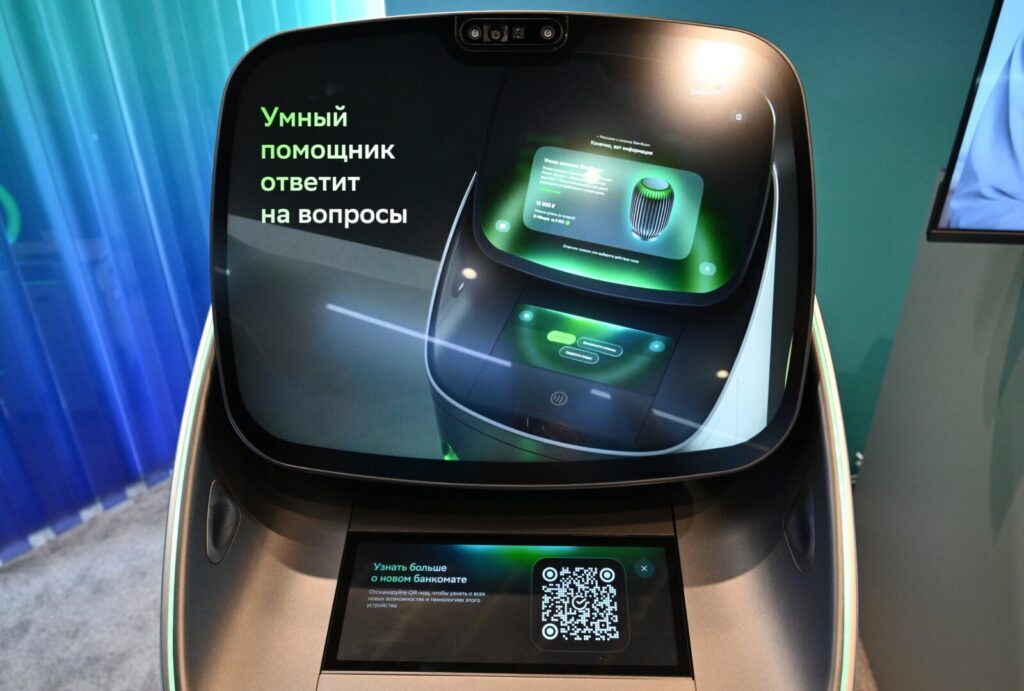
Secondly, AI assistants can replace sales managers, for example, in bank branches – on interactive stands,and kiosks. The AI assistant interprets the client’s request, even if it is formulated blurry, and identifies a specific need. It also advises on existing products and helps to make a choice, leads the client according to the service scenario within the bank’s ecosystem.
Today, many large banks have AI assistants. For fintech companies, attracting AI to direct customer service is an opportunity to reduce the burden on employees and transfer more priority issues to them. For clients, it is possible to get a faster answer, and sometimes a more complete one, to speed up the execution of tasks: not to go all the way in the application manually, but simply to give the command to the assistant.
Prospects for the development of AI in Russian fintech
Most of the experts who participated in the study “Bank of the Future: How Do Customers and Experts See It?” from OTP Bank, FinTech Association and NAFI believe that AI has a positive impact on the development of the banking sector. It is AI that will continue to stimulate the transformation of Russian fintech in the coming years.
Classic machine learning models in scoring, anti-fraud and forecasting have already become a “hygienic minimum” – this is what participants in the insurance market say, and the same can be said about the banking segment of fintech. Now generative AI is coming to the fore.
In particular, AI agents will make a great contribution to the financial industry, as shown by the FinTech Association’s study “3 × 10 Trends of 2026.” They are becoming a significant part of the global financial market, and the Russian one is largely following the same trends. AI agents will become a development driver for Russian fintech – in internal processes, anti-fraud system, and in work with clients.
Many users of fintech products have a positive attitude towards AI in financial services. Therefore, in 2025, every third (33%) private investor turned to AI to form a portfolio: in 2024, there were only 19% of them, according to a study by Выберу.ру and IT Smart Finance.
Business customers who took part in the Markwebb study expect internet banking to become more convenient thanks to AI. Entrepreneurs want to see functional AI agents who will save time in daily tasks – preparing documents, fixing payment orders. The ideal assistant is described as Alice: to say in a voice “make a payment there for such and such an amount” – and he will do everything himself.
It is important to note that fintech now does not have a single operation that most customers would be willing to fully trust with AI, as the Bank of the Future study shows. At this stage, it is important for people that AI is still under human control. This may be due to fears of “hallucinations” of neural networks and insufficient transparency of decision-making.
Manufacturability, reliability and convenience are integral characteristics of the fintech products of the future. This manufacturability will largely be ensured precisely thanks to the increasingly active introduction of AI, and no longer through point products, but through comprehensive programs.

By Ivan Konovalov, founder and CEO of Molver