



For the first time in the history of office employment, the employer offers employees the opportunity choice: work from home, in the company’s office or in coworking. Choice of flexible office spaces have recently become increasingly popular both among employees and employers. We analyze why.
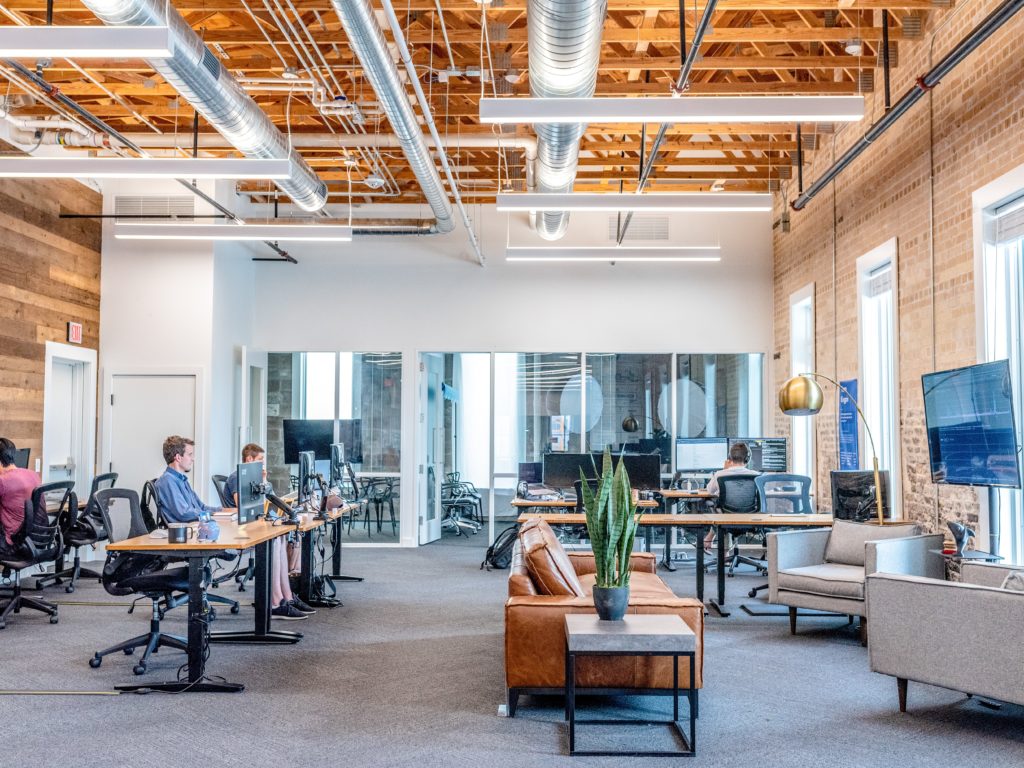
Turnkey Office
The forced reduction of corporate costs during the pandemic continued after exit from lockdowns. Companies have found that they can significantly save on leasing office space by transferring employees to full or partial remote work. Part of the staff is ready to work from home, the rest can rent places in smart offices. Over the past year, their popularity has doubled, and their market share is now estimated at 3%.
The proverb that one relocation is equal to three fires does not work in the case of coworking. Representatives of office hospitality know how to transport rather large teams literally for one day, and corporate customers use it. Depending on time and requests companies can choose a standard smart office or build-to-suit projects. Anyway, base positions will be in their places: tables, outlets, Wi-Fi, printer connection, security of physical and information perimeters.
Due to the unstable epidemiological and economic situation, companies find it difficult to predict attendance at workplaces. Coworking offers different solutions of this problem — from hotdesking (when one workplace accounts for two or three employees) to the offer “office by subscription” (when the company pays only for employees, who really come to the smart office).
Closer to home
The flexibility of rental conditions soon will remain one of the main trends on the flex office market. If most recently such proposals were mainly in the capital, then soon, networks will begin to actively come out with similar offers at regional markets. For corporations, the price difference in labor markets in the regions is still the possibility of saving money.
In megacities, smart offices are also getting closer to staff. Last year, operators already tested the format of coworking at home, opening locations outside the Third Ring — in fact in sleeping areas. Obviously, this topic will be actively developed. Employees receive pleasant bonuses in the form of several hours of free time at home instead of stress in traffic jams and enormous checks for fuel. As a result — motivation for self-development, disclosure of creative potential, job satisfaction, dedication.
In the world, this trend has already become widespread: global networks offer workers a product that fills the space between home and office.
“People want to regain their homes and see colleagues again, but they don’t need long daily trips to work and monotonous routine, which entails returning to old full-time office, ” points out Doug Chambers, chief operating officer of Daybase — New York’s network of flexible offices close to sleeping areas, which opened in 2020.
The company positions them as an ecosystem that is not limited to time and place.
Comfort and creativity
The idea of a smart office smoothing out the conflict between home and office automatically involves the creation of a comfortable environment: both in the sense of space and in terms of community. Both will be included in the tariff.
“The workplace of the future is more a club than a cabinet,” Bloomberg columnist describes so the latest office trends.
There should be not only a working space, but also restoration area, a place for sports and activities, coffee snack. Beautiful, cozy, fashionable, environmentally friendly. It must be a place, where you can find inspiration and where you want to return.
You can feel really good only where there are “your own people”, those with whom you are on the same wave. In the West, creating communities based on flexible offices becomes independent industry. Residents come to coworking for the sake of the workplace, and remain in it because of the people who fill it.
Russian operators also followed this trend. Increasingly, they offer residents joint hiking in the mountains, jeep tours, yachting or making them friends at Friday beer parties or for co-viewing movies. Now, together with office meters and infrastructure security, self-respecting networks also offer enterprise customers HR-assistance.
Author: Ekaterina Belova, Marketing Director of SOK Smart Office Network